DARK LADIES AND LUNAR BLOOD
By d.g.k goldberg
 |
Micki's novel is a dazzling work of alternative history employing meticulous research to create a setting for vibrant characters. However, she dares to invade male territory---she writes with considerable knowledge of war.
Ms. Hayden is a self-described small woman, she mentions a literary event including "names" and "bottom feeders such as myself" where she was over- looked, nearly ignored not simply because she was female, but because she was a little woman, diminished somehow by her child-like stature into a lesser role.
As Micki recounts her experience, I think of 19 year old Mary Shelley, writing Frankenstein as part of a "story contest" during a house party involving the big "names" of romantic poetry---Byron, and her own husband Shelley. It is difficult to get through college without knowing that we should admire the romantic poets---and dating at least one angst ridden poseur attempting to masquerade as a Byronic hero. Whether we actually do admire the romanticists, or read them, we all know the story of Frankenstein, penned by a young woman often overlooked by the leading literary lights of her era.
Anecdotal wisdom reports that Mary Shelley
learned to read during the course of daily walks with her father to the grave of
her mother, noted feminist Mary Wollstonecraft in the St. Pancras churchyard. Little
Mary learned her letters tracing the tombstone inscription on her mama's grave. Only
sixteen when she ran away to live with unhappily married poet Percy Shelley, Mary
became a social outcast. Even her father, who she
eventually supported with her pen, rejected her for her scandalous behavior.
Mary idolized her husband, seeing Percy as the iconoclast, the genius that would outlive their lifetime. Her own work still stands as seminal in understanding the conflict between people and technology and spawned generations of science fiction writers who questioned the morality of artificial life.
Mary's half-sister Fanny Imlay and Shelley's
first wife Harriet both committed suicide shortly before Mary wrote Frankenstein.
Following Harriet's death, Mary married Shelley. The couple suffered the loss of
two young children. When Mary was merely 24, Percy Shelley drowned leaving Mary a
penniless pariah with a two-year-old son to support. Is it any wonder she wrote horror?
Or, is the horror in her marginalization? A world that worshipped the dashing male
poets in their stark black suits had little room for a woman. Mary wrote for the
rest of her life and managed only a subsistence existence of genteel poverty. In
many ways Mary's is a contemporary story-the solitary mother ill-
provided for with an aging parent and a dependent child---a common thread in the
tapestry of woman's experience.
"I think a woman's experience lends itself nicely to dark fiction. We live dark fiction. Inferior wages, exclusion from "the Good Old Boys Clubs" in the workplace . . .It makes us attuned to the more subtle nuances of the dark side of life. As far as my writing's publishability, sometimes I think "hard" horror is more salable, that a little more adventure in my plotlines would make a difference between a sale and a rejection. But I find the horrible part of true life is the subtle part: not just the murder of a loved one, which, God knows, is horrible enough, but the eternal extrapolation of what that means.
For example, watching a loved one being murdered
and being helpless to stop it is terrifying beyond words. But the after effects of
the act, the frustration, the guilt, the missing a part of you, is there forever---doesn't
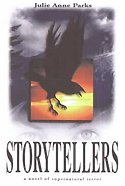
go away, and eats at your soul." Julie Anne Parks, author of Storytellers, (ISBN
1891946048) is highly conscious of the varying shades of horror in the modern world,
her writing weaves ancient myths into modern settings from the perspective of a woman
who has experienced the a range of
the experiences the 20th century offers women. Julie has been a deferential flight
attendant and an assertive news reporter. She has lived in the urban north and the
rural south. She is a daughter and a mother. Her novel Storytellers encompasses the
horror of a loveless relationship as well as supernatural terror.
Meeting Julie, I was immediately mesmerized
by her eyes,deep-set-drifting from amber to autumn leaf in tone. She speaks girl-friend
language well; we quickly commiserated over the impossibility of finding panty hose
that fit and the incomprehensibility of cosmetic
packaging. I considered asking, "What's a nice girl like you doing writing tales
of supernatural terror?"
Beyond the common ground women share, Julie sees the mundane madness of our era with the eyes of a woman attuned to the subtle shifts of atmosphere and light that color the world. "Perhaps it's a result of life in the 90's, where we are so linked up that we find cell-phone cancer a more believable threat than a swamp creature, a threatening asteroid hit more frightening than a guy glued together from body parts," she says. "Literature reflects the times of the author: the times are scary."
During my adolescence, I sprawled on my bed devouring science fiction and horror novels. I longed for a world where I could teleport myself through time or captain a starship---my initial role model was a bright adolescent heroine, Podkayne of Mars penned by golden age great Robert Heinlien. Poddie, as endearing as she was, left me a tad uncomfortable-I had the sense she looked like the sort of girl that always had a Friday night date and could easily have made cheerleader while maintaining a 3.5 GPA, and what she wanted.
. . .well, it seemed to be men and babies. The more I read of the science fiction Masters, the more discouraged I became. It seemed as if to colonize a distant planet or discover a cure for global plagues I needed flowing hair and large breasts. I lost interest in physics about the same time I resigned myself to life in an "a" cup bra.
Steve Algeiri, editor of EternityOL and Pulp
Eternity acknowledges that the "golden age" of science fiction was primarily
a boys club. He reminded me of award winning writer Ursula K. LeGuin whose contracts
stipulated that her byline could not be changed to mask her gender. According to
Steve, "some of the most powerful innovative speculative fiction today is being
written by women." In both his print and on-line magazine's Steve publishes
the work of many women writers. Issue 6 of Pulp Eternity is a themed issue containing
only stories about "women of empowerment." Steve is an editor looking for
good stories, not writers of a particular gender. Times have changed from the days
when Dr. Alice Sheldon wrote as James Tiptree, Jr. because she suspected that a male
pen name would have a better chance at publication.
Thomas Strauch, publisher of the Design Image Group, a small press publishing only horror, seemed surprised when I pointed out that half of his anthology authors were women. His publishing house is committed to "traditional horror." In seeking marketable material, the gender of the author is not an issue. He did comment that if he'd come up with an all female anthology it might have "suggested a marketing approach."
Margaret Carter, whose novel Shadow of the Beast (ISBN 189194603X) has a strong female protagonist, is one of the authors that Design Image publishes. As a scholar, editor of the small press magazine The Vampire's Crypt, and as a writer she has given considerable thought to gender and genre. When I asked her about being a woman and a writer, she clarified the evolution of the current generation of dark ladies.
"For most of my life I have seen the two categories as separate,since I didn't think about my sex while writing. In fact, starting out with mostly male authors as models, I usually wrote about male protagonists. That has changed, though mainly in the spirit of "write what you know" rather than a feeling that I "should," write about women."
Margaret has published a number of scholarly works and short stories about vampires. She says, "Almost all the vampires in my fiction, whether they are the protagonists or not, are male. Lately I have become more conscious of gender issues and begin to think that I "ought" to write about a strong female vampire character. However, my fiction focuses mainly on love relationships between vampires and human "donors", so the vampire is almost always male and the human partner female---because I'm a heterosexual female and its MY fantasy, blast it!"
Margaret's impassioned words alter me as much as Dracula's bite ever could.Maybe the dark ladies of today are following Mary Shelley's renegade tradition---maybe a chorus of female voices is shouting, "it's my fantasy, my nightmare, my terror, my perception, and I will present it."
Margaret adds that, "I am dubious about
any writer's trying to create what he or she "ought" to be writing; one
has to be passionately involved . . ." I think about the pejorative terms used
to restrain women---the belittling of our focus on relationships, the slight sneers
regarding our intensity in matters emotional and the stream of PMS jokes on cable
TV. I understand Julie's perspective; we are uniquely equipped to see the horror
in the details of dailyness. I applaud Margaret's freedom in owning her fantasies.
I see a
future where woman can write "the other things."
Copyright 1999 Moxie Magazine All Rights Reserved