SEPIA MEMORIES IN THE COLD LIGHT OF DAY
by Sylvia Carr
 WHEN
I WAS A CHILD, my grandmothers seemed perfect. They cooked better than my parents,
had more time for me, and weren't around for the day-to-day conflicts I indulged
in with my nuclear family. But as I grew up, I learned about their varied pasts,
and my view of them was tainted forever.
WHEN
I WAS A CHILD, my grandmothers seemed perfect. They cooked better than my parents,
had more time for me, and weren't around for the day-to-day conflicts I indulged
in with my nuclear family. But as I grew up, I learned about their varied pasts,
and my view of them was tainted forever.
The first thing I knew about my father's mother, Sylvia, was that I was named after her. She always called me, her namesake, proudly, using both my first and middle name "Sylvia Marie" to make a distinction between us, even though we all called her Grammy. I appreciated how she addressed me as if I were an adult, because that is how I felt.
Almost every Sunday when I was little, my parents, four sisters, and I would go to her house after church, help her fix the food, then sit down to a huge meal of well-cooked meat, boiled vegetables, and powdered milk. Always, there were fruit filled jello molds for dessert. The Depression had taught her to be thrifty and make do.
Grammy was not a cuddly grandmother. I never sat on her lap. Instead I stood by her rocking chair, my arms at my sides, while we spoke. We talked about my grades at school, about the parts I played in school musicals, and about her favorite TV show, Donahue, which I watched too after school sometimes.
The biggest treat was when she read aloud. She had an expressive, grand voice that filled the living room. My sisters and I would lie haphazardly across the many plush chairs and couches listening to the stories. Our favorites were the Sherlock Holmes mysteries she read from a hard-bound volume that filled her lap. She told us that when she was a teenager she used to tell these same stories to her partners in dancing school, then leave them at the cliff hanger, so they'd be back to dance with her the next week. When she was young, the boys lined up to dance with her.
Even when she was an older woman, Grammy always said, "I'd rather dance than eat," though by that time she could not dance. Rheumatoid arthritis crippled her body. The last twenty years of her life, she hobbled from room to room of her cluttered house in her brightly colored polyester dresses, her hands so gnarled she could barely peel onions, her hips impossibly wide.
My other grandmother, my mother's mother, was named Lilo, but we always called her Hase, pronounced with two syllables (HAH - za). Her husband gave her the nickname, which means "rabbit" in German, because her nose wrinkled when she laughed.
I saw Hase on holidays, like Easter and the Fourth of July, at chaotic bilingual family gatherings. The adults yelled to each other in German (genetic hearing loss affected them all) while the children ran through the house not understanding, playing poker for M&Ms in a bedroom upstairs.
Ours was not a verbal relationship. Hase spoke mostly German. Her heavily accented words made her seem foreign, strange, distant. I spoke only English. Yet I knew she understood me, somehow, secretly.
Hase was kind. She always gave me a warm, close-lipped smile when I walked into the buttery-smelling kitchen to watch her bake. She baked vigorously, using her whole body, kneading dough so hard it made her sweat. She had bony, quick hands that whipped cream and rolled out pie crusts perfectly. As I watched her from the doorway, I saw that she had a sadness to her. Though her body was slim and her hands quick, her steps were heavy.
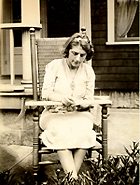
I BECAME CURIOUS about my grandmothers' pasts when I was eight or nine years old. I found a picture of Grammy in one of my father's photo albums. She was young: her skin smooth, her fingers long and slender, her knees perfectly round, her legs crossed delicately at the ankles. In the photo, she was sitting in front of an unfamiliar house, doing needlework in a wooden rocking chair.
I was old enough to know that my grandmother had been young, and her body more able than the one I saw each Sunday, but seeing her youthful body in this picture was so jarring that it was like meeting a whole new grandmother, one I could judge as a peer. It made me want to know more. At around age ten I started asking my parents about both of my grandmothers.
My father told me that Grammy was principled and proud. As a teenager living in Boston, she walked to school instead of paying for the bus, and wouldn't buy sodas at the drug store, so she could save money to buy high-heeled Italian boots. She kept those boots until the day she died.
Grammy was a great performer, too. At twenty-two,
she studied voice with a famous man who offered her a career in musical theater.
Perhaps too practical for an artist's life, she finished college instead, and got
a job teaching English to high-school classes of 40 in inner city Boston. A few years
later she married a Methodist minister from Vermont, where she raised my father and
my aunt Audrey. There Grammy's performing talents were used only to sing solos in
the choir and direct the farmers' children in musical
revues.
Hase came from an important family in Germany. Her father, a doctor, ran one of the country's best hospitals. As a teenager, she wore fur coats and lived in a beautiful house. Once she ice-skated with the Prince of Denmark.
When Hase's father died suddenly, her mother sent Hase and her sister to medical school instead of marrying them off. As a result, Hase became one of the first women to graduate medical school in Germany. She won As from professors who had never before seen a woman in their classroom.
She'd told my mother that the first surgery she observed was particularly hard. "Everyone faints," she was warned. Indeed, when the day for the operation came, her male classmates were fainting left and right. But during her turn Hase kept conscious by biting her lip until it bled. Only later, alone in the women's bathroom, did she let herself collapse.
Hase worked as a doctor in Berlin during World War II, and somehow managed to protect her five children from the danger around them. Once Hase took the children into a bomb shelter for the night, afraid that the air raid would be particularly bad. The next morning the family found a bomb in my four-year-old mother's bed.
At the war's end, Hase brought the children
to Bavaria, where they were reunited with their father. After seeing the city devastated,
perhaps she believed life in the country would be kinder. They rented an old farm
house, milking a cow for sustenance. Hase proved her enormous competence and resourcefulness
on that farm. She scrounged together the ingredients for a cake on each child's birthday
and made sweaters out of the sheeps' wool caught on the barbed wire fences. One Christmas,
she created a teddy
bear out of an old glove for Peter, the youngest. Indeed, my mother remembered this
as the happiest time in her childhood.
These stories came to me as revelations, making
Grammy and Hase much more
exciting than my hum-drum parents.
BUT, AS I BECAME A TEENAGER, I saw more troubling sides of them too. I heard Grammy
call her neighbors' children "picanninnies," which I knew was not right--as
was her complaining about how terrible it was that "the blacks were moving into
the neighborhood." In my maturing eyes, her pride soured to snobbery when she
deemed my sister's working-class boyfriend "not the marrying sort."
Just before I entered high school, one of my
uncles told me that Hase had been a member of the Nazi party back in Germany. My
mother said it was just to get medical supplies, that she couldn't have survived
as a doctor had she not joined the party. But my uncle said that Hase believed the
Nazi rhetoric until the day she died. Once, on Long Island, where she and her husband
settled in their later years, she read a newspaper
headline announcing the local Jewish community's petition to make Yom Kippur a school-wide
holiday. She tightened her hand into a fist, and hissed, "Didn't they learn
anything in the war?"
As mothers, I realized they were less than perfect. Grammy's no-nonsense way of dealing with children left my father longing for unconditional love his whole adult life. Hase allowed her husband to be physically violent with my mother and her siblings.
Rumors about their marriages circulated among my cousins. To this day I have no idea if they are true. Grammy's husband, though seemingly pleasant and docile, had an underhanded way of getting what he wanted at home. Hase's husband supposedly had several mistresses, one of whom he brought home to live with the family when housing was scarce after the war. Hase cooked breakfast for both her husband and the other woman each morning, much to her chagrin.
Where were my righteous, strong-minded grandmothers in these stories? Discovering my parents' faults was something I was prepared for, but not so with my grandmothers. Hearing these stories for the first time was shocking and painful. It made all the good memories--the fairy tales, the fresh bread, their warm laps--feel less real. My grandmothers taught me to be honest. But I felt I had been deceived.
By the time I learned these stories, I was in my teens and my grandmothers were showing their age. Hase was very thin, very deaf, and often weak and tired. Grammy was becoming more and more bitter, after watching both her husband and her only daughter die. It seemed hardly the right time to ask my questions about the darker parts of their lives. Why did they choose what they chose? How could they disappoint me like this?
Indeed, the idyllic spell my grandmothers cast over me in childhood was so strong that as a teenager I could not find the words to speak with them about these events. As a result, they both died before I could confront them, and my feelings for them are now somehow mixed.
I know I love them, but do I understand them? Do I truly respect them? I feel ashamed for even questioning them, as if it is the ultimate disrespect to speak badly of loved ones, especially the dead.
My grandmothers still serve as role models for me. They were smart, strong, and gifted. They both worked outside of the home when most women did not. They ran their households and spoke their minds.
I only wish that I had spoken when I could--to ask them what really happened, and to hear them simply say, "I'm not perfect, and that is nothing to be ashamed of." Instead the only voice I hear is my own, criticizing them and wondering about the truth.
Copyright 1999 Moxie Magazine All Rights Reserved